Introduction:
Shilajit is a natural substance found in mountain regions, including the Himalayas. It has been used in traditional wellness practices for many years. It is usually dark brown or black and may look like thick resin, a powder, or a processed supplement. Many people buy shilajit because they are interested in traditional remedies, energy, and general wellness. However, not every product sold as shilajit is pure or safe.
Understanding Real vs Fake Shilajit is important before buying or using this mountain substance. Some products may contain fillers, low quality ingredients, or harmful contaminants. Others may be made from materials that look similar to natural shilajit but do not have the same composition.https://indianherbs.org/
The Himalayan region of Gilgit Baltistan, Pakistan, is known for its high mountains, remote valleys, and traditional knowledge of natural resources. Shilajit is associated with Himalayan mountain environments, and its name is often connected with these regions. However, a seller’s claim that a product comes from Gilgit Baltistan does not automatically prove its purity or safety.
What Is Shilajit?
Shilajit is a dark, mineral rich organic substance that develops over long periods through complex natural processes involving plant material, microorganisms, and rock environments. It is found in some mountainous regions, particularly across parts of the Himalayas.
Natural shilajit contains a mixture of organic compounds and minerals. Fulvic acid and humic substances are among the components commonly discussed in shilajit research. The exact composition can vary depending on the source, environmental conditions, and processing methods.https://rawshilajit.co.uk/
Shilajit is traditionally collected from mountain rocks during certain seasons. Raw material may contain soil, stones, and other unwanted substances, so it needs appropriate purification and quality control before it can be considered suitable for consumption.
When discussing Real vs Fake Shilajit, it is important to understand that a naturally sourced product is not automatically safe. Natural materials can contain toxic metals or other contaminants. Proper testing is therefore essential.
Real vs Fake Shilajit,Pure shilajit is not identified by its color alone, its price, or the place where a seller claims it was collected. Reliable identification requires evidence about its composition, purity, and safety.Admin confirmation
Real vs Fake Shilajit: Why Is It Important to Know the Difference?
The market for traditional wellness products includes many brands with different manufacturing practices. Some companies provide detailed laboratory reports, while others make strong claims without offering clear evidence.
Learning about Real vs Fake Shilajit can help buyers avoid products with unknown ingredients or misleading labels.There are several reasons to check shilajit carefully.
1. Product quality: Genuine shilajit has a complex chemical composition. A product containing mostly fillers may not match its label.
2. Contamination risks: Poorly collected or processed shilajit may contain lead, arsenic, mercury, or other unwanted substances.
3. Misleading health claims: Some sellers promise immediate energy, increased strength, or solutions to many health problems. Such claims are not proof of quality or effectiveness.
4. Unclear sourcing: A label may mention the Himalayas without providing information about the actual source, manufacturer, or purification process.
5. Consumer protection: Checking reliable testing records helps buyers compare products using evidence instead of marketing language.
A product can look natural and still be contaminated. Likewise, a dark, sticky resin can be manufactured or mixed with other ingredients. This is why laboratory testing is more dependable than appearance alone.
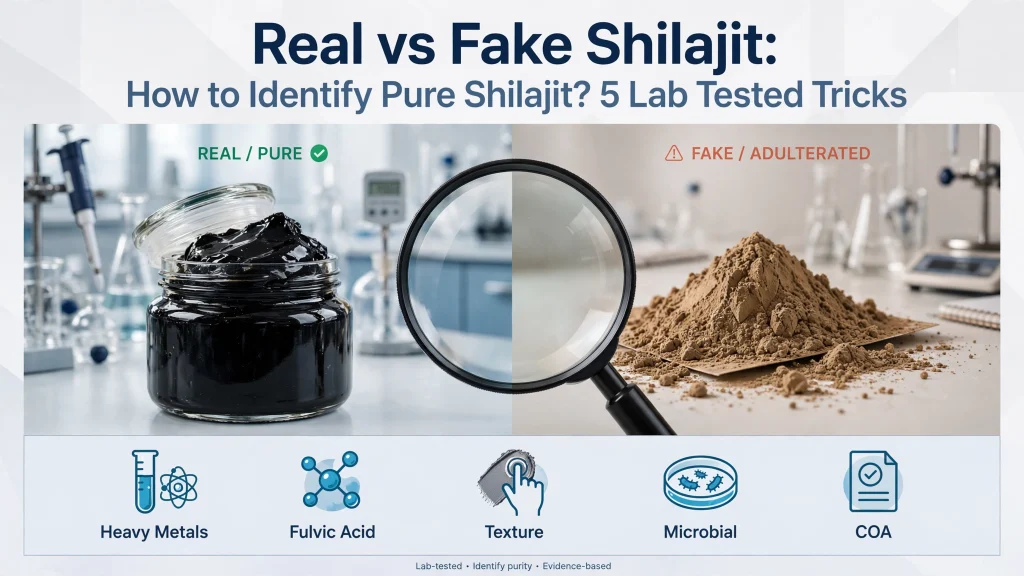
Real vs Fake Shilajit is not just about color, it’s about safety. Real Shilajit is a glossy, black brown resin that softens in your warm hand, dissolves completely in warm water giving a golden-brown color with no residue, and has over 50% fulvic acid with heavy metals under safe limits. Fake Shilajit is often a dull brown powder or hard rock mixed with flour, soot, or cheap chemicals, it doesn’t dissolve properly, leaves residue, has low fulvic acid, and can contain dangerous levels of lead and arsenic. The only way to be 100% sure is a lab report (ICP-MS for heavy metals and fulvic acid test).
5 Lab Tested Tricks to Identify Pure Shilajit:
The most dependable way to investigate Real vs Fake Shilajit is to combine laboratory testing with careful product checks. The following five methods are based on scientific testing approaches used to examine ingredients, chemical composition, and contamination. They are not five home experiments, and they cannot all be performed with household tools.
Trick 1: Use ICP MS or ICP OES Testing for Heavy Metals:
One of the most important steps in checking shilajit quality is testing for heavy metals. Natural substances can absorb or contain elements from the rocks and surrounding environment. Some elements are needed in small amounts, but others can be harmful when exposure becomes excessive.https://sattvic.com
ICP-MS (Inductively Coupled Plasma Mass Spectrometry) and ICP-OES (Inductively Coupled Plasma Optical Emission Spectrometry) are laboratory techniques used to measure elements in samples.
A laboratory can use these methods to check for contaminants such as:
- Lead (Pb)
- Arsenic (As)
- Mercury (Hg)
- Cadmium (Cd)
- Other elements relevant to the sample and its intended use
These tests are important because a product may look natural while still containing unsafe levels of contaminants.
A published study examining shilajit samples obtained from Pakistan and India detected several potentially toxic elements and highlighted the need for careful elemental analysis. Another study published in 2025 investigated thallium in natural shilajit and commercial supplements, reinforcing the importance of broader contamination testing.
When researching Real vs Fake Shilajit, ask the seller for a recent certificate of analysis (COA) from a qualified laboratory. The report should identify the product or batch, show measured results, and explain the relevant testing limits.
Do not accept a report that simply says “heavy metals tested” without giving meaningful results. A laboratory report should show which metals were tested and their measured concentrations, usually in units such as parts per million (ppm) or milligrams per kilogram (mg/kg).
Also, do not assume that detecting a metal automatically means a product is unsafe. The amount, exposure, applicable standards, and intended use all matter. A qualified professional should interpret the results against appropriate limits.What this trick tells you: It helps determine whether the tested batch meets relevant contaminant limits. It does not, by itself, prove that a product is genuine shilajit.https://indianexpress.com/
Trick 2: Check Fulvic Acid and Humic Substances:
Fulvic acid and other humic substances are often discussed when describing shilajit’s chemical composition. Their presence and measured amounts can provide useful information about a sample, but there is no single universal percentage that proves every shilajit product is pure.
Laboratories can use methods such as high-performance liquid chromatography (HPLC), ultraviolet-visible spectroscopy, or other validated analytical techniques, depending on the compound being measured and the laboratory’s method.
The correct method matters because shilajit is a complex mixture. A test that measures one chemical fraction cannot automatically identify every ingredient in the sample.
When comparing Real vs Fake Shilajit, consider these questions:
- Does the manufacturer state the amount of fulvic acid or another specified component?
- Does the laboratory report identify the analytical method?
- Are the results reported for the same product and batch?
- Does the report explain the method’s limitations?
- Are the manufacturer’s claims consistent with the laboratory findings?
A product label might advertise a high fulvic acid percentage. However, the number alone is not proof of authenticity. Different methods can produce different results, and some methods measure broader groups of compounds rather than a single pure substance.
Be cautious when a seller claims that a particular fulvic acid percentage proves a product is 100% genuine. A trustworthy assessment uses several types of evidence instead of relying on one attractive number.
What this trick tells you: Chemical profiling helps assess whether the sample matches its stated composition. It should be interpreted alongside safety testing and other quality checks.
Trick 3: Use Chromatography and Spectroscopy for Chemical Fingerprinting:
A chemical fingerprint is a pattern of compounds or signals that helps scientists compare one sample with another. Laboratories may use chromatographic and spectroscopic methods to study the composition of complex natural products.
For example, chromatography can separate components in a mixture, while spectroscopy can provide information about chemical structures or functional groups. The selected technique depends on what scientists want to identify.
For shilajit, an analyst may compare the sample’s chemical profile with authenticated reference material or established specifications. Real vs Fake Shilajit,A substantial difference may indicate that further investigation is necessary.
However, a chemical fingerprint does not always provide a simple yes-or-no answer. Natural shilajit can vary because of its geological origin, processing, and storage. Real vs Fake Shilajit,A reliable comparison must account for these differences.In the Real vs Fake Shilajit investigation, this method is useful for examining suspicious products that may contain added substances or have an inconsistent composition.
Ask whether the laboratory:
- Used a suitable analytical method for the question being investigated.
- Compared the results with a relevant reference or specification.
- Examined whether the sample’s composition was consistent with the product label.
- Reported limitations or unexplained findings.
A product that produces a similar chemical fingerprint to reference material may still contain contaminants. That is why fingerprinting should not replace heavy-metal testing.
What this trick tells you: ,Real vs Fake Shilajit,Chemical profiling can reveal unusual composition and support an authenticity assessment, especially when suitable reference samples and validated methods are available.
Trick 4: Request Microbial and Other Contaminant Testing:
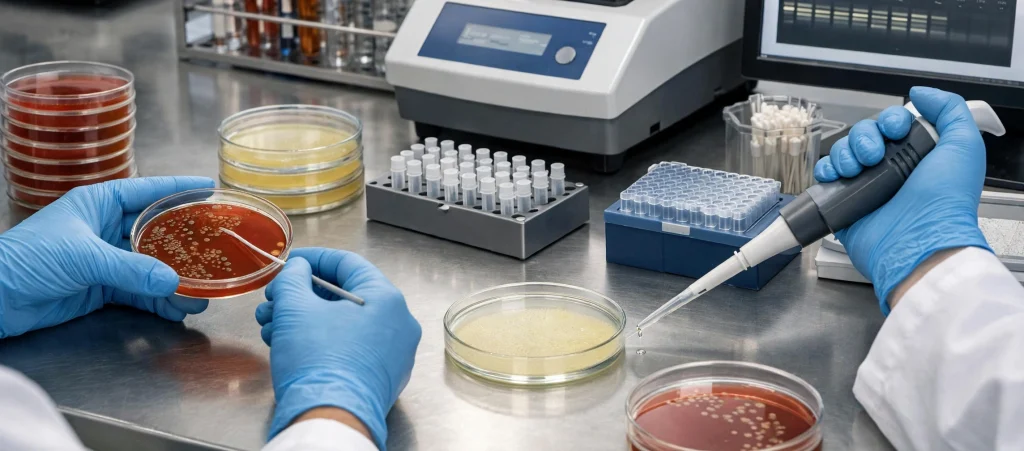
Not every quality problem involves fake ingredients. Real vs Fake Shilajit,A product may contain genuine shilajit but still be unsuitable for consumption because of contamination during collection, processing, packaging, or storage.
Microbiological testing can help determine whether specified microorganisms are present at unacceptable levels. Depending on the product and its manufacturing process, a quality-control program may also assess moisture, pesticides, mycotoxins, or other relevant contaminants.
The laboratory should select tests appropriate for the sample and its intended use. Not every product requires exactly the same panel, and a test for one contaminant does not establish that every other contaminant is absent.
This is another essential part of Real vs Fake Shilajit because a product’s appearance does not reveal whether it has been contaminated during production.Before buying, check whether the manufacturer can provide:
- A batch-specific laboratory report.
- Information about purification and manufacturing controls.
- Relevant microbial results.
- Additional contaminant results where appropriate.
- Clear storage instructions and an intact seal.
A report from an earlier batch may not represent the product currently being sold. Ideally, the batch number on the report should match the batch number on the package.
It is also important to understand the phrase “not detected.” It means that the tested substance was not detected above the method’s reporting or detection threshold under the conditions used. It does not necessarily mean that the substance is completely absent.
What this trick tells you: It helps assess whether the product meets relevant hygiene and contaminant specifications.For people interested in Himalayan wellness products, Gilgit Baltistan can be an important part of the discussion. Nevertheless, the geographical origin of a product should be supported by evidence rather than assumed from a label.It does not independently confirm the geographical source or authenticity of shilajit.https://harbelremedies.com/blog/
Trick 5: Verify the Certificate of Analysis and Product Traceability:
A certificate of analysis is a document that reports laboratory findings for a sample or product batch. It can be one of the most practical tools available to consumers, provided it is genuine, relevant, and detailed enough to evaluate.When comparing Real vs Fake Shilajit, do not judge a product only by a certificate displayed in an advertisement. Check the details.
A useful certificate should ideally include:
- The product name and sample identification.
- The batch or lot number.
- The date of testing.
- The name of the laboratory.
- The analytical methods used.
- The measured results and units.
- Relevant acceptance limits or specifications.
- Authorized reporting or verification details.
Where possible, verify the report directly with the laboratory using independently obtained contact details. Check whether the laboratory has appropriate accreditation for the specific tests performed. Accreditation for one type of testing does not necessarily cover every method in a report.
Also examine whether the report belongs to the manufacturer, product, and batch being advertised. A certificate for another product or an unrelated batch is not sufficient evidence.
For buyers in Pakistan, the Drug Regulatory Authority of Pakistan provides information about quality-control laboratories and the testing of therapeutic goods. You can consult its Quality Control Labs page.
Drug Regulatory Authority of Pakistan:
What this trick tells you: Traceable, batch-specific documentation gives you stronger evidence about the product’s tested quality than unsupported claims such as “100% pure” or “lab tested.”Remember that even an authentic certificate covers only the sample and tests described in it. It is not a guarantee against every possible quality problem.
Real vs Fake Shilajit: 5 Simple Home Tests:
Laboratory analysis is the most dependable way to evaluate important quality and safety questions. However, you can also observe how a product behaves at home. Real vs Fake Shilajit,These simple checks may help you notice unusual characteristics, but they cannot confirm purity.https://harbelremedies.com/category/uncategorized/
1. The Warm Water Test:
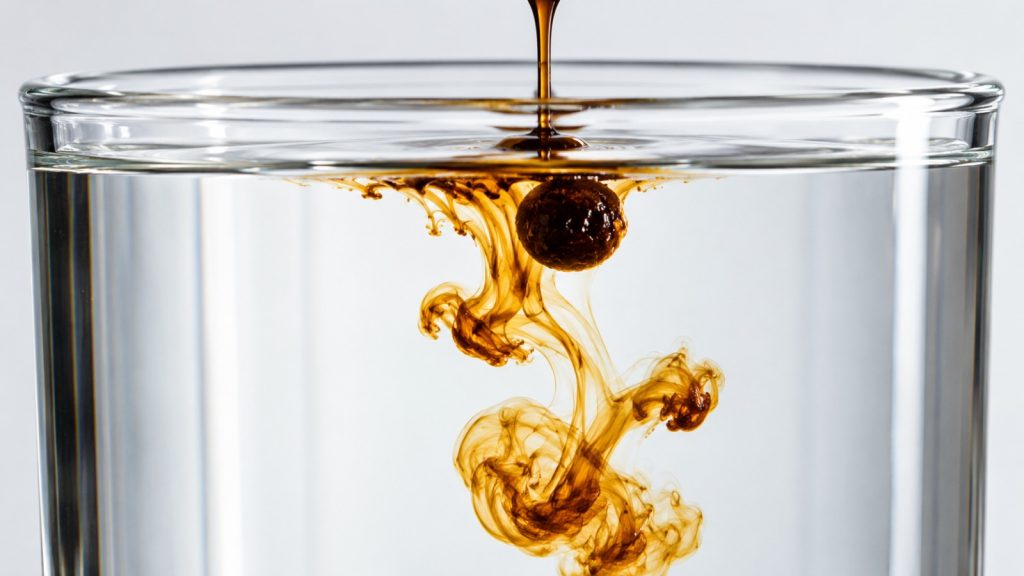
Some shilajit resins soften and disperse in warm water. You can place a tiny amount in a clean glass of warm water and observe what happens.A sample may gradually dissolve or produce a brownish solution. However, this behavior is not unique to genuine shilajit. Other substances can also dissolve or disperse in water.https://harbelremedies.com/blood-pressure-control-in-2026/
If a product leaves visible particles, that does not automatically mean it is fake. The result depends on the sample and its composition.For Real vs Fake Shilajit, consider this test an initial observation only. Do not drink the test solution, especially when the product’s safety has not been established.
2. The Temperature Test:
Some resin products become softer when warm and firmer when cool. Shilajit may show similar changes because of its physical properties.You can observe a small sample at normal room temperature and notice whether its consistency changes under ordinary conditions.
Avoid placing the material in direct flame, using a lighter, or heating it strongly. Real vs Fake Shilajit,Burning a product is not a reliable purity test and may produce harmful fumes.Real vs Fake Shilajit,Changes in texture alone cannot distinguish authentic shilajit from every imitation. Other sticky materials may behave similarly.
3. The Texture Test:
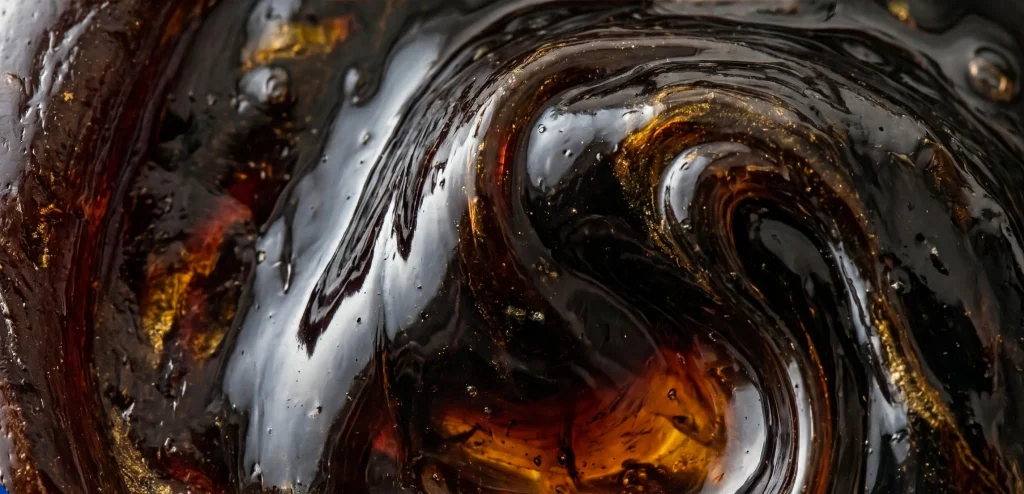
Shilajit resin is commonly described as thick, sticky, and dark. Its consistency may change with temperature, processing, and storage.
Observe whether the product appears consistent with the manufacturer’s description. Real vs Fake Shilajit, Look for unexpected foreign material, unusual packaging residues, or signs of poor storage.
However, do not assume that every genuine sample has exactly the same texture. Natural variation exists, and manufacturers may produce different formulations.A smooth resin is not automatically genuine, just as a firm resin is not automatically fake.
4. The Smell Test:
Real vs Fake Shilajit,Some shilajit products have a distinctive earthy or mineral like smell. The intensity may vary between samples.An unusually strong fragrance or a chemical-like odor may be a reason to ask the seller for more information. However, smell is subjective and cannot identify individual ingredients or contaminants.
Never taste an unknown sample to determine whether it is authentic. For people interested in Himalayan wellness products, Gilgit-Baltistan can be an important part of the discussion. Nevertheless, the geographical origin of a product should be supported by evidence rather than assumed from a label.,https://harbelremedies.com/2026/09/29/berberine-for-blood-sugar/
Taste cannot establish purity, and unsafe contaminants may have no noticeable smell or flavor.
5. The Label and Packaging Test:
Packaging can provide useful clues about a seller’s reliability. Real vs Fake Shilajit,Check the product name, ingredient list, batch number, expiry or best-before information, manufacturer details, and safety seal.
Real vs Fake Shilajit,Be cautious if the package contains spelling mistakes, conflicting ingredient information, missing manufacturer details, or claims that sound too good to be true.https://harbelremedies.com/neem-and-besan-face-pack-for-pimples/
A QR code or barcode is not proof of purity by itself. It should lead to information that can be independently verified.These home observations can support your research into Real vs Fake Shilajit, but they should never replace suitable laboratory testing.
Shilajit from Gilgit Baltistan: What Should Buyers Know?
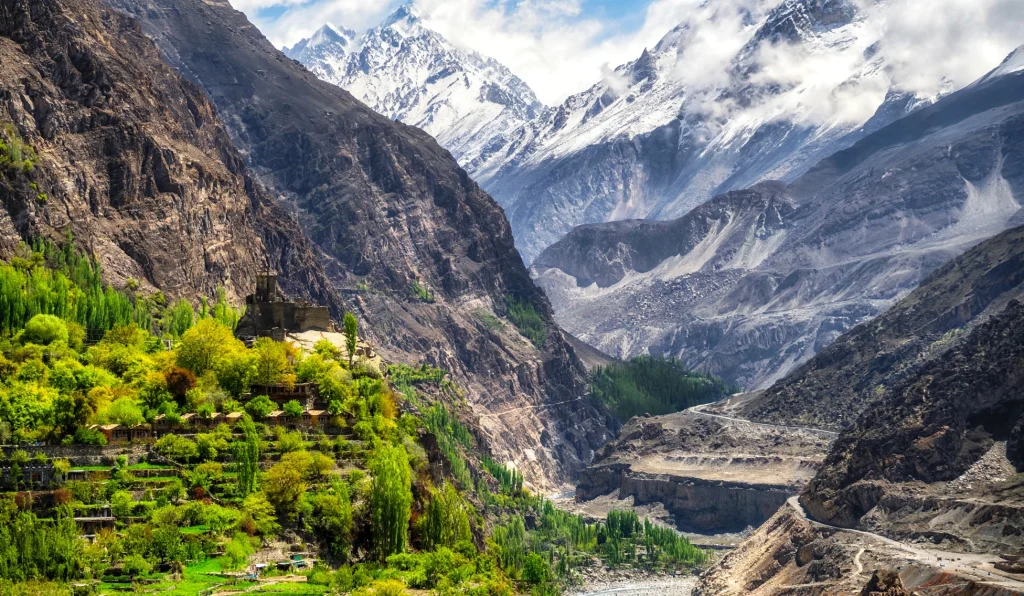
Gilgit Baltistan is known for its spectacular Himalayan and Karakoram landscapes, traditional mountain communities, and natural resources. Shilajit is associated with mountainous areas in this region, and local knowledge of mountain products has been passed between generations.https://harbelremedies.com/2026/09/26/what-are-herbal-remedies/
For people interested in Himalayan wellness products, For people interested in Himalayan wellness products, Gilgit Baltistan can be an important part of the discussion. Nevertheless, the geographical origin of a product should be supported by evidence rather than assumed from a label.,
Gilgit Baltistan can be an important part of the discussion.Real vs Fake Shilajit, Nevertheless, the geographical origin of a product should be supported by evidence rather than assumed from a label.
Research has specifically examined the heavy-metal profiles of shilajit samples obtained from Gilgit and Chellas in Pakistan. Real vs Fake Shilajit,The study detected several elements, including lead, in the tested samples, demonstrating why material from a natural mountain environment still requires proper quality assessment.https://harbelremedies.com/knee-pain-relief-2026/
MySitasi
This does not mean that all shilajit from Gilgit-Baltistan is unsafe. It means that products from the region should be assessed individually.When purchasing Himalayan shilajit, ask the seller:
- Can you explain where the raw material was collected?
- Is the source information supported by reliable documentation?
- Has the product undergone appropriate purification?
- Is a batch-specific certificate of analysis available?
- Have heavy metals and other relevant contaminants been tested?
- Can the laboratory and its results be independently verified?
A genuine source claim is useful, but it does not establish that a finished product is safe for consumption.Understanding Real vs Fake Shilajit is particularly important when buying directly from online sellers or small suppliers who may not provide detailed manufacturing information.https://harbelremedies.com/herbs-for-weight-loss-2026/
Supporting responsible local businesses can help preserve regional knowledge and economic opportunities. At the same time, buyers should expect clear quality standards, transparent sourcing, and evidence of safety.
Common Warning Signs of Fake or Poor Quality Shilajit:
Some warning signs should encourage you to investigate a product before buying it.Real vs Fake Shilajit,Unrealistic health claims: Be cautious when sellers promise instant results, guaranteed testosterone increases, cures for chronic diseases, or benefits for every health problem.https://harbelremedies.com/20-powerful-medicinal-herbs/
No batch information: A product without a clear batch or lot number is harder to trace and verify.Unverifiable laboratory reports: A report without a recognizable laboratory, sample identification, or relevant results provides limited evidence.
Extremely low prices: A very cheap product may deserve additional scrutiny, although price alone cannot prove that a product is fake.Unclear ingredients: Products with incomplete ingredient lists or unexplained additives require careful investigation.Pressure to buy immediately: Sellers who refuse to answer basic questions about testing or safety may not be trustworthy.https://harbelremedies.com/natural-herbs-for-blood-sugar/
Claims of absolute purity: No seller should expect you to accept a purity claim without appropriate supporting evidence.When considering Real vs Fake Shilajit, remember that no single warning sign proves fraud. The strongest decision comes from considering the product’s documentation, laboratory results, manufacturing information, and seller reliability together.
Is Pure Shilajit Always Safe?
No. Authenticity and safety are different questions.A sample may contain genuine shilajit and still have unwanted levels of heavy metals or other contaminants. Scientific literature has highlighted the importance of examining the composition and safety of shilajit products.
Raw shilajit should not be assumed suitable for direct consumption. Use only products intended for the relevant use and supported by appropriate quality controls.
Evidence for many claimed health benefits remains limited, and results from studies of one preparation may not apply to every commercial product. Shilajit should not replace prescribed medicines or professional medical care.
People who are pregnant or breastfeeding, children, and people with medical conditions or who take regular medication should seek advice from a qualified healthcare professional before using a shilajit supplement.The best approach to Real vs Fake Shilajit combines authenticity checks with a separate assessment of safety and suitability.https://harbelremedies.com/category/city-tours/adventure/
FAQs:
1. How can I identify real shilajit?
Look for a reputable manufacturer, clear ingredient information, traceable sourcing, and a batch specific laboratory report. Appropriate chemical analysis and heavy metal testing provide stronger evidence than appearance or home experiments. No single home test can confirm authenticity.
2. Does real shilajit dissolve in warm water?
Real vs Fake Shilajit,Some shilajit resins dissolve or disperse in warm water, but this behavior is not exclusive to genuine shilajit. The test cannot establish purity or safety.https://harbelremedies.com/blood-pressure-control-2026/
3. Can fake shilajit look exactly like real shilajit?
Yes. Imitation products may resemble genuine resin in color, texture, and appearance. Real vs Fake Shilajit,Visual inspection alone cannot reliably distinguish every imitation from authentic material.
4. Is shilajit from Gilgit-Baltistan always pure?
No. Gilgit-Baltistan is associated with Himalayan shilajit, but geographical origin does not guarantee purity. Products still need suitable purification, quality control, and laboratory testing.
5. Which laboratory test is best for shilajit?
There is no single test that answers every question. ICP-MS or ICP-OES can assess elemental contaminants, while appropriate chromatographic or spectroscopic methods can help evaluate chemical composition. Microbiological tests may also be necessary. The correct combination depends on the product and the risks being assessed.
6. What is a certificate of analysis?
A certificate of analysis, or COA, is a report containing laboratory results for a sample or product batch. Real vs Fake Shilajit,Check the batch number, test dates, methods, measured values, and laboratory details. Verify the report where possible.
7. Does a high fulvic acid percentage prove purity?
No. Fulvic acid measurements can provide information about composition, but a high reported percentage does not independently establish authenticity or safety. The analytical method and other quality results also matter.
8. Is shilajit resin better than shilajit powder?
Not automatically. Resin and powder are different product forms, and quality depends on the material, processing, composition, and contamination controls. Compare laboratory evidence rather than choosing based only on the form.
9. Can I identify fake shilajit by burning it?
No. Burning is not a reliable authentication method and may produce harmful fumes. Real vs Fake Shilajit,Use suitable laboratory testing instead of flame-based experiments.
10. Should I buy shilajit without laboratory testing?
It is better to choose a product with credible, relevant testing and traceable documentation. Without such evidence, you cannot confidently assess important safety and quality concerns.
Conclusion
Understanding Real vs Fake Shilajit requires more than checking color, smell, texture, or price. Home observations can provide basic clues, but they cannot confirm authenticity or detect every harmful contaminant.The five most useful laboratory based approaches are heavy metal analysis, chemical composition testing, chemical fingerprinting, microbial and other contaminant testing, and verification of a reliable certificate of analysis.
For buyers interested in shilajit from Gilgit Baltistan, regional origin and traditional knowledge are valuable parts of the story, but they should be supported by transparent sourcing and scientific quality checks.Always choose products from responsible sellers, verify laboratory reports, and avoid unsupported medical promises. Genuine shilajit should not simply look natural; its quality and safety should be supported by credible evidence.The key lesson is simple: when comparing Real vs Fake Shilajit, trust verified laboratory results more than marketing claims or home tests.